


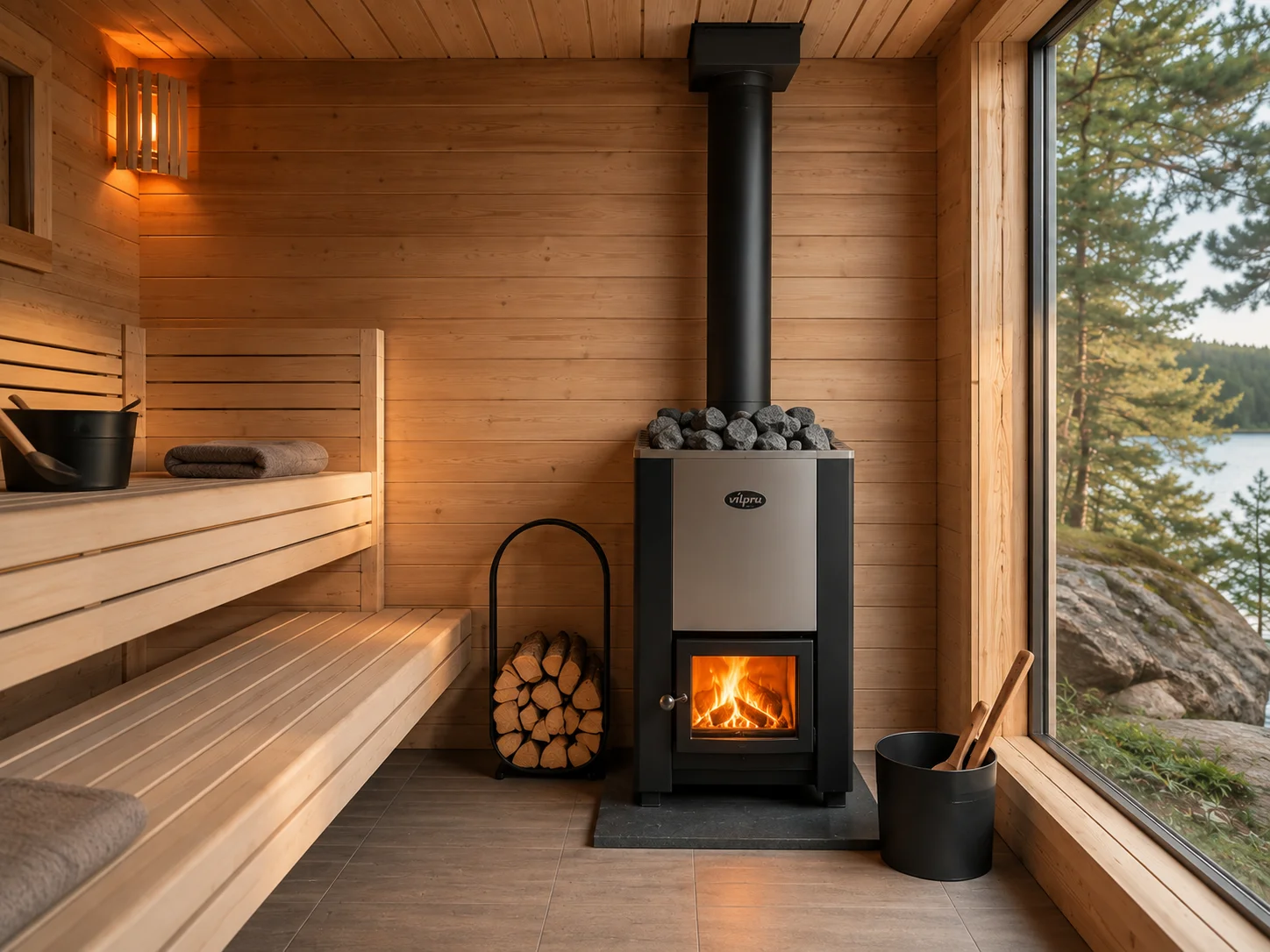
Choosing the right wood-burning sauna stove starts with a simple question: how large is the sauna? However, the answer is not always limited to multiplying length, width, and height.
Sauna volume is the starting point. The final stove choice also depends on wall materials, glass areas, insulation, outdoor conditions, stone capacity, flue outlet diameter, chimney route, and the manufacturer’s recommended sauna volume range.
A stove that is too small may struggle to heat the sauna. A stove that is too large may heat the air too quickly, while the stones may not have enough time to store sufficient heat. The best result is achieved when the stove, sauna volume, stones, chimney set, clearances to combustible materials, and installation conditions are planned together.
In this guide, we explain how to calculate sauna volume and use it to choose the right wood-burning sauna stove.
Why Sauna Stove Size Matters
The size of a wood-burning sauna stove affects comfort, heating time, fuel use, steam quality, and installation planning.
If the stove is too small, the sauna may take too long to heat up or may not reach the desired temperature. In this case, users may try to overfire the stove, but this is not the right solution.
If the stove is too powerful, it may heat the air quickly, but the stones may not be ready to produce good-quality steam. The sauna may feel hot, but the heat will be less balanced and the steam less pleasant.
That is why sauna stove size should not be chosen only by appearance or price. First, calculate the sauna volume, then evaluate the real heating conditions.
Step 1: Calculate the Basic Sauna Volume
First, calculate the sauna volume in cubic metres. The formula is simple:
Sauna volume = length × width × height
For example, if the sauna is 2.4 m long, 2.0 m wide and 2.2 m high, its volume is:
2.4 × 2.0 × 2.2 = 10.56 m³
This number is the starting point. It helps you understand which recommended stove volume range you should begin with. However, the basic volume alone is not always enough, because sauna heating is also affected by glass areas, stone, concrete, tiles, log walls, insulation quality, and whether the sauna is located outdoors in a cold climate.
Step 2: Evaluate Materials and Heat Loss
The calculated sauna volume is not yet the final number by which the stove is automatically chosen. Two saunas can be the same size but heat very differently. A well-insulated indoor wooden sauna will heat more easily than an outdoor sauna with large glass doors, a stone wall section, or uninsulated logs.
In practice, you can use the following indicative logic:
- if the sauna is well insulated, wooden, and has no large cold surfaces, start with the actual calculated volume;
- if there are uninsulated glass, stone, tile, or concrete surfaces, you can add about 1.2 m³ of sauna volume for every 1 m² of such surface;
- if the sauna has uninsulated log walls, it is worth multiplying the basic sauna volume by approximately 1,5, because logs take longer to absorb heat
- if the sauna is outdoors and used in a cold climate, especially in winter or in a windy location, choose a stove closer to the higher end of the manufacturer’s recommended volume range.
For example, if your sauna’s basic volume is 9 m³and the selected stove is recommended up to 10 m³, at first glance it still fits the range. However, if the sauna has, for example, 2 m² of glass door or stone surface, you can add to the volume about 2,4 m³. In this case, the volume used for stove selection is no longer 9 m³, but approximately 11,4 m³.
If the same sauna is also an outdoor sauna used during the cold season, a stove whose limit is 10 m³ may be too close to its maximum capacity. In this case, it is worth looking at models from a larger range or choosing a stove where your sauna is closer to the middle of the recommended volume range rather than at the very top.
This is not a strict technical formula, but a useful practical rule: the more cold surfaces, weaker insulation, and colder surroundings there are, the more carefully you should approach a stove that only just fits the upper limit of its recommended range. The final choice should always be checked against the manufacturer’s documentation and installation conditions.
Step 3: Compare the Adjusted Volume with the Stove Range
Once you have the basic sauna volume and have evaluated heat losses, compare the adjusted number with the stove manufacturer’s recommended sauna volume range.
For example, if the sauna is 9 m³, but because of glass, stone, or outdoor conditions you assess it as 11–12 m³, a stove whose recommended range ends at 10 m³becomes a riskier choice. It may still look suitable based on the basic volume, but in real conditions it may work close to its limit.
When comparing stoves, look not only at whether the number “fits” into the range, but also where your sauna sits within that range:
- if the sauna volume is in the middle of the range, the choice usually has more reserve;
- if the volume is near the upper limit, glass, stone, logs, insulation, and outdoor conditions should be evaluated more carefully;
- if the adjusted volume already exceeds the range, it is worth looking at the next stove size group;
- if the sauna is very close to the boundary between two ranges, the final decision should be checked against the product documentation and the installer’s recommendation.
In other words, you should not choose the smallest stove only because the basic number still “fits.” It is better to evaluate real conditions and choose a model with enough reserve for normal use.
Step 4: Evaluate Stone Capacity and Heating Feel
Sauna stove size is not only about room volume. Stone capacity also matters.
Stones store heat and influence how the sauna feels when water is thrown on them. A larger stone capacity can help maintain a more stable heat reserve and a softer steam feel. A smaller stone capacity may heat up faster, but it stores less energy.
When comparing stove models, check:
- recommended sauna volume;
- maximum stone capacity;
- stove weight;
- water tank option, if relevant;
- flue outlet diameter;
- certificates and documentation.
Some compact sauna stoves can still have a fairly large stone capacity, while larger models are chosen for bigger rooms or a different heating feel. The best choice is the one that matches both the sauna volume and the desired sauna experience.
Step 5: Do Not Forget the Flue Outlet Diameter
The stove choice is directly connected to the chimney solution.
A wood-burning sauna stove should not be chosen separately from the chimney set. The flue outlet diameter, chimney height, route, draught, clearances to combustible materials, and roof penetration should all be planned together.
In the Vilpra Sauna range, the flue outlet diameter indicated for sauna stoves is 115 mm. After choosing the stove model, the next step is to match it with a suitable sauna chimney set and installation route.
This is especially important because a sauna chimney often passes through the ceiling and roof. The solution should include suitable chimney sections, roof sealing elements, supports, and safe clearances to combustible materials.
Read more in the article: “Sauna Stoves and Chimney Sets: What Should a Safe Sauna Chimney Setup Include?”
Example: Choosing a Stove for a 10 m³ Sauna
Let’s say the sauna dimensions are:
- length: 2.2 m;
- width: 2.0 m;
- height: 2.2 m.
The basic volume is:
2,2 × 2,0 × 2,2 = 9,68 m³
At first glance, this may look like an approximately 10 m³ sauna. However, you now need to check whether there are any additional heat losses.
If the sauna has a 1.8 m² glass door, you can add approximately:
1,8 × 1,2 = 2,16 m³
The volume used for stove selection then becomes:
9,68 + 2,16 = 11,84 m³
If there is also a small stone or tile area, for example 1 m², you can add another 1,2 m³. The real selection volume would then already be around 13 m³.
This means that a stove theoretically designed for up to 10 m³ may be too close to the limit for this sauna. In this case, it is better to look for a model whose recommended volume range covers not only the basic 9.68 m³ number, but also the adjusted 12–13 m³ need.
If this sauna is also outdoors and used in winter, it is worth choosing a model where the adjusted volume is not at the very top of the range. This gives the stove more reserve on cold days and helps maintain more stable heating.
This example does not replace the manufacturer’s instructions, but it shows the right logic: first calculate the basic volume, then evaluate cold surfaces, insulation, and environmental conditions.
Common Mistakes When Choosing Sauna Stove Size
Mistake 1: Choosing by Floor Area Only
Sauna height is very important. A 6 m² sauna with a low ceiling and a 6 m² sauna with a higher ceiling will not have the same volume. Always calculate cubic metres, not just floor area.
Mistake 2: Ignoring Glass and Cold Surfaces
Glass, stone, tiles, concrete, and uninsulated logs absorb more heat than well-insulated wooden walls. If these surfaces are not considered, the stove may look suitable based on the room volume in m³, but in practice the sauna may heat more slowly or struggle to maintain the desired temperature.
Before choosing a model, it is worth not only calculating length, width, and height, but also checking how many cold or harder-to-heat surfaces the sauna has.
Mistake 3: Choosing the Smallest Model That Barely Fits the Range
If your sauna volume is close to the upper limit of the stove range, be careful. Real conditions may make the sauna harder to heat than the simple calculation suggests.
Mistake 4: Oversizing the Stove Too Much
A larger stove does not always mean a better result. If the stove is too powerful, it may heat the air too quickly and create a less balanced sauna experience.
Mistake 5: Forgetting the Chimney
The stove, flue outlet diameter, chimney height, draught, roof penetration, and sauna chimney set should be planned together. The stove size selection is not complete until the chimney solution has also been checked.
Mistake 6: Applying Indoor Sauna Logic to an Outdoor Sauna
An outdoor sauna, especially one used in winter, has a higher heat demand than an indoor sauna of the same volume. Cold air, wind, and ambient temperature affect how quickly the sauna heats up and how steadily it holds heat.
That is why an outdoor sauna should not be sized only by the basic volume. If the sauna is near the upper limit of the stove’s range, it is worth considering a larger model or choosing one where the sauna sits closer to the middle of the recommended range.
Practical Checklist Before Choosing a Stove
Before choosing a wood-burning sauna stove, answer these questions:
- What are the sauna length, width, and height?
- What is the basic sauna volume in m³?
- Are there large glass surfaces?
- Are there stone, brick, concrete, or tile surfaces?
- Is the sauna indoors or outdoors?
- Is the insulation quality clear?
- Which stove models cover the calculated m³ range?
- Is the selected stove not at the very upper limit of its recommended volume range?
- Does the adjusted sauna volume still fit within the selected stove range?
- What stone capacity is preferred?
- What flue outlet diameter does the stove require?
- Which sauna chimney set matches the stove?
- Are clearances and installation requirements confirmed?
- Has the final choice been checked by a qualified installer?
- Are there uninsulated log walls in the sauna?
- Will the sauna be used outdoors during the cold season?
How Vilpra Industries Helps Match Stove Size and Chimney Set
Vilpra Industries sauna stoves are presented with recommended sauna volume ranges, so the selection can begin with a clear m³ figure. Product data also includes stone capacity, stove weight, flue outlet diameter, water tank information where applicable, and certificates.
This is useful because a sauna stove can be evaluated not only by size, but by the full setup: sauna volume, desired stone capacity, whether a water tank is relevant, the required chimney diameter, and which sauna chimney set will be matched.
| Vilpra Sauna model | Output | Recommended sauna volume | Weight | Stone capacity | Chimney diameter | Best suited for |
| Grannus Queen VPR-8 | 8 kW | 6–10 m³ | 25 kg | 60–70 kg | 115 mm | Smaller saunas where a larger stone mass is desired in a compact volume |
| Grannus Queen VPR-8 L | 8 kW | 6–10 m³ | 28 kg | 60–70 kg | 115 mm | Smaller saunas where a larger stone mass is desired in a compact volume with an external firebox |
| Flamo VPR-14 | 14 kW | 7–13 m³ | 50 kg | 30–35 kg | 115 mm | Medium-sized saunas where a clear 7–13 m³ range solution is needed |
| Fornax VPR-14 | 14 kW | 7–13 m³ | 50 kg | 30–35 kg | 115 mm | Medium saunas where the basic or adjusted volume falls within the 7–13 m³ range |
| Fornax-E Queen | 8 kW | 7–13 m³ | 46 kg | 95–105 kg | 115 mm | Medium saunas where higher stone capacity, eco-friendliness, and better energy efficiency are relevant |
| Fornax Queen VPR-14 | 14 kW | 7–13 m³ | 46 kg | 105 kg | 115 mm | Medium saunas where a FORNAX-type solution with large stone capacity is preferred |
| Etna VPR-22 | 22 kW | 10–24 m³ | 70 kg | 40–50 kg | 115 mm | Larger saunas or situations where the adjusted volume already exceeds the medium range |
| Etna VPR-22 L | 22 kW | 10–24 m³ | 74 kg | 40–50 kg | 115 mm | Larger saunas or situations where the adjusted volume already exceeds the medium range, with an external firebox |
For example, if the basic sauna volume is 9 m³, but because of glass or colder surfaces you assess it as 10.5–11.5 m³, it is worth being cautious with models that end at the 10 m³ limit. In this case, it is more practical to compare models intended for the 7–13 m³ range, especially if you want more reserve in real conditions.
If the sauna is already approaching 13 m³ , or after heat-loss adjustments you calculate it as larger, models in a higher range should be considered. If not only sauna volume but also the heating feel matters, stone capacity is worth checking: some models in the same 7–13 m³ range have a 30–35 kg stone capacity, while others offer up to 100 kg.
Vilpra sauna chimney sets can also be planned together with the stove. The catalogue indicates that these sets are universal for Vilpra sauna stoves, made from stainless steel, can be extended with additional sauna chimney elements, and remove combustion products by natural draught. Surface options include stainless steel or black painted finish.
Frequently Asked Questions
Measure the sauna length, width, and height in metres, then multiply these numbers. The formula is: length × width × height.
For example, a sauna that is 2.4 m long, 2.0 m wide, and 2.2 m high has a basic volume of 10.56 m³.
No. Floor area alone is not enough because ceiling height changes the amount of air that needs to be heated.
Before choosing the size of a wood-burning sauna stove, always calculate sauna volume in cubic metres.
A 10 m³ sauna may sit near the boundary between smaller and medium stove ranges, depending on the manufacturer. Look at models whose recommended sauna volume includes 10 m³.
If the sauna has glass, stone surfaces, or weaker insulation, a larger range may also need to be considered.
Large glass areas can increase heat demand, so the sauna may be more demanding than the basic volume suggests.
However, a larger stove should not be chosen automatically. Check the manufacturer’s recommendations and confirm the final choice with a qualified installer.
Yes. A stove that is too powerful may heat the air too quickly and create a less balanced sauna experience.
Good sauna comfort depends not only on air temperature, but also on properly heated stones.
Stones store heat and affect steam quality when water is poured on them. A larger stone capacity can help maintain a more stable heat reserve and a softer sauna feel.
Stone capacity should be evaluated together with sauna volume and the desired heating style.
Yes. Stove size and model determine the flue outlet diameter, chimney route, draught requirements, clearances to combustible materials, and the suitable sauna chimney set.
The stove and chimney should be planned as one system, not as two separate decisions.
As a practical rule, for every 1 m² of uninsulated glass, stone, tile, or concrete surface add to the sauna volume about 1,2 m³.
For example, if the sauna volume is 9 m³, but it has 2 m² of glass, the volume used for stove selection may be about 11.4 m³. This helps you understand whether the selected stove is too close to the upper limit of its recommended range.
Often, yes. An outdoor sauna in a cold climate has higher heat losses than an indoor sauna of the same volume. Cold air, wind, ambient temperature, and insulation quality can all increase the real heating demand.
For an outdoor sauna, it is better to choose a stove with more reserve rather than one sitting at the very top of its recommended volume range. The final choice should always be checked against the manufacturer’s documentation and installation conditions.
Conclusion
Choosing the right wood-burning sauna stove size starts with calculating sauna volume, but the basic length × width × height number is not the only criterion. Glass, stone, tile, concrete, or uninsulated log surfaces, insulation quality, and whether the sauna is used indoors or outdoors in a cold climate should also be considered.
If the sauna has cold surfaces, it is worth adding an additional “equivalent” volume to the basic calculation. If the sauna is outdoors and used in winter, it is better to choose a stove with some reserve rather than one at the very top of its recommended range.
The best result is achieved when not only sauna volume is evaluated, but the full setup: stove, stone capacity, chimney set, clearances to combustible materials, installation route, and real usage conditions.


