


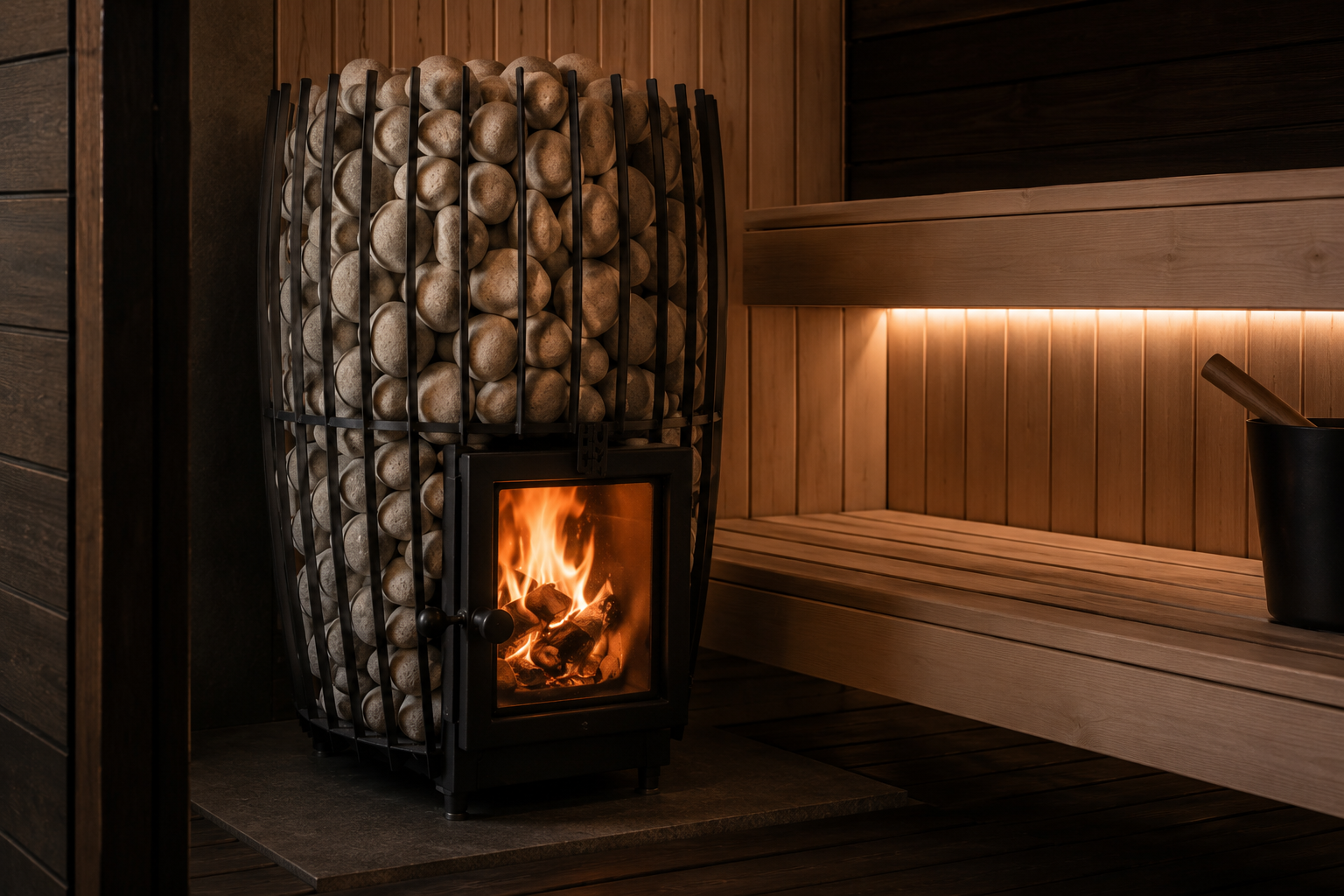
Chimney mistakes in a sauna can be more dangerous than in a typical living space. A sauna contains a lot of wood, the room is often compact, temperatures are high, and the chimney frequently passes through the ceiling and roof. That is why a safe sauna stove chimney should be planned as a complete set, not as a single pipe attached to the stove.
The right solution must safely remove combustion products, maintain proper draught, pass through building structures, and be selected according to the specific sauna stove. It is important to evaluate not only the flue pipe itself, but also penetrations, clearances to combustible materials, roof sealing, fixing elements, and maintenance access.
In this article, we explain what a sauna chimney set should include, which mistakes to avoid, and what should be checked before installing a sauna stove.
What Makes a Sauna Chimney Setup Different?
A sauna is a small, hot, and usually wooden space. Because of this, sauna stove installation requires more attention than connecting a regular stove in a living room.
It is important to evaluate not only stove output, but also the chimney route, clearances to combustible materials, the ceiling penetration, roof sealing, fixing, and protection against accidental contact with hot surfaces.
Safety does not depend on one element alone. It depends on the entire system: the stove, flue pipe, insulated parts, penetrations, terminal, maintenance access, and installation according to the manufacturer’s instructions.
Start with the Sauna Stove, Not the Pipe
The main rule is simple: first choose the sauna stove, then match the sauna chimney set to it.
The following should be evaluated:
- sauna room volume;
- stove model and output;
- flue outlet diameter;
- required chimney height;
- whether the route will pass through the ceiling, wall, or roof;
- the sauna stove manufacturer’s installation requirements.
A stove that is too weak may struggle to heat the room, while a stove that is too powerful may heat a small space too quickly and make safe clearance planning more difficult. The flue pipe for a sauna stove should also not be chosen “by eye” — its diameter and system must match the documentation of the specific appliance.
What Should a Sauna Chimney Set Include?
A proper sauna chimney set should cover the entire route from the stove to the point where combustion products are discharged outside.
In most cases, the following should be considered:
- a connecting pipe from the stove;
- an insulated chimney section;
- a ceiling or roof penetration solution;
- a roof flashing or sealing element;
- a chimney terminal;
- supports and fixing elements;
- additional modules if greater height is required;
- protection against contact with hot surfaces;
- cleaning and inspection access.
A stainless steel sauna chimney is often chosen because of its durability, clear system logic, and resistance to operating conditions. However, final suitability must always be assessed according to the stove model, installation location, and local requirements.
The Most Important Safety Points
In a sauna, clearances to combustible materials are especially important. Wood, benches, walls, ceilings, and finishing details may be close to the stove or chimney, so distances must not be reduced simply because the sauna is small.
Another sensitive area is the passage through the ceiling and roof. Improvised solutions are not suitable here. Dedicated components should be used to help protect structures from overheating and to ensure the roof is properly sealed.
It is also important to consider the risk of accidental contact. In a sauna, people move in a small space, often barefoot and in high temperatures, so hot chimney parts must be planned in a way that does not create unnecessary risk.
Common Sauna Chimney Installation Mistakes
One of the most common mistakes is buying the stove and chimney separately without checking compatibility. The stove’s flue outlet diameter, draught requirements, chimney height, and installation route should all be assessed together.
Another mistake is failing to plan the ceiling and roof penetrations. These areas often become the most complicated part of the installation, so they should be planned in advance.
It is also dangerous to reduce safe clearances because of limited space. A small sauna is not a reason to ignore the manufacturer’s instructions or local fire safety requirements.
Another mistake is forgetting about cleaning and inspection. The chimney must be accessible for maintenance, because even a correctly installed system will accumulate soot over time and needs regular inspection.
Vilpra Industries Sauna Stoves and Chimney Sets
In the Vilpra Industries range sauna stoves and Saunas chimneys are presented as mutually compatible solutions. This is important because flue gas exhaust for a sauna stove should not be planned from random parts, but as a coordinated system.
Vilpra sauna chimney sets are made from stainless steel, can be extended with additional modules, and are designed to remove combustion products by natural draught. Different surface options are also available, such as stainless steel or black painted finish.
These chimney sets are relevant when the goal is to plan the stove connection, chimney height, penetrations, and final appearance more easily as one complete solution.
Practical Checklist Before Installation
Before installing a sauna stove and chimney, it is worth checking:
- which stove model will be installed;
- what sauna room volume it is designed for;
- what the flue outlet diameter is;
- what chimney height and route are required;
- whether the chimney will pass through the ceiling, wall, or roof;
- whether clearances to combustible materials have been confirmed;
- whether roof flashing and sealing elements are included;
- whether supports and fixings are required;
- whether protection against contact is needed;
- whether cleaning and inspection access is planned;
- whether local requirements have been checked;
- whether compatibility has been confirmed by a qualified professional.
Frequently Asked Questions
A sauna chimney set should include a connecting pipe, insulated chimney sections, ceiling or roof penetration solutions, roof sealing, a terminal, fixings, and maintenance access.
It is important that these parts are compatible with the specific sauna stove and installation location.
No. A flue pipe for a sauna stove must be selected according to the stove documentation, flue outlet diameter, temperature conditions, chimney route, and installation requirements.
A randomly chosen pipe may fit physically, but still be technically unsuitable.
A sauna contains a lot of wood and operates at high temperatures. That is why clearances to walls, ceilings, benches, and other combustible surfaces are one of the most important safety considerations.
These clearances must be defined according to manufacturer instructions, product designation, and applicable requirements.
Stainless steel is often chosen for sauna chimneys because of its durability, resistance to operating conditions, and clear system logic. This is especially relevant when the goal is to use a coordinated chimney set rather than separate, unverified parts.
However, the material alone is not enough. A sauna chimney must be selected according to the stove model, flue outlet diameter, route, clearances to combustible materials, and installation instructions.
Some sauna chimney sets can be extended with additional modules if the project requires greater height or a different route.
It is important to use compatible elements, not random parts from different systems.
A sauna stove chimney should be installed by a qualified professional following the stove and chimney manufacturer’s instructions.
This is especially important because of clearances to combustible materials, penetrations through structures, and chimney draught.
A sauna chimney should be inspected regularly, especially before the active use season. If the sauna is heated often, inspection and cleaning become even more important.
The exact frequency should be determined by a professional based on usage intensity, fuel, and installation conditions.
The biggest mistake is planning the stove, chimney, penetrations, and safe clearances separately.
A safe sauna chimney setup must be planned as one system: from the stove to the chimney terminal.
Conclusion
A safe sauna chimney is not just one pipe. It is a coordinated solution where the sauna stove, flue outlet diameter, chimney height, penetrations, clearances to combustible materials, fixings, and maintenance access all matter.
The best result is achieved when the sauna stove and chimney set are planned together, rather than assembled from separate, unverified parts.


