


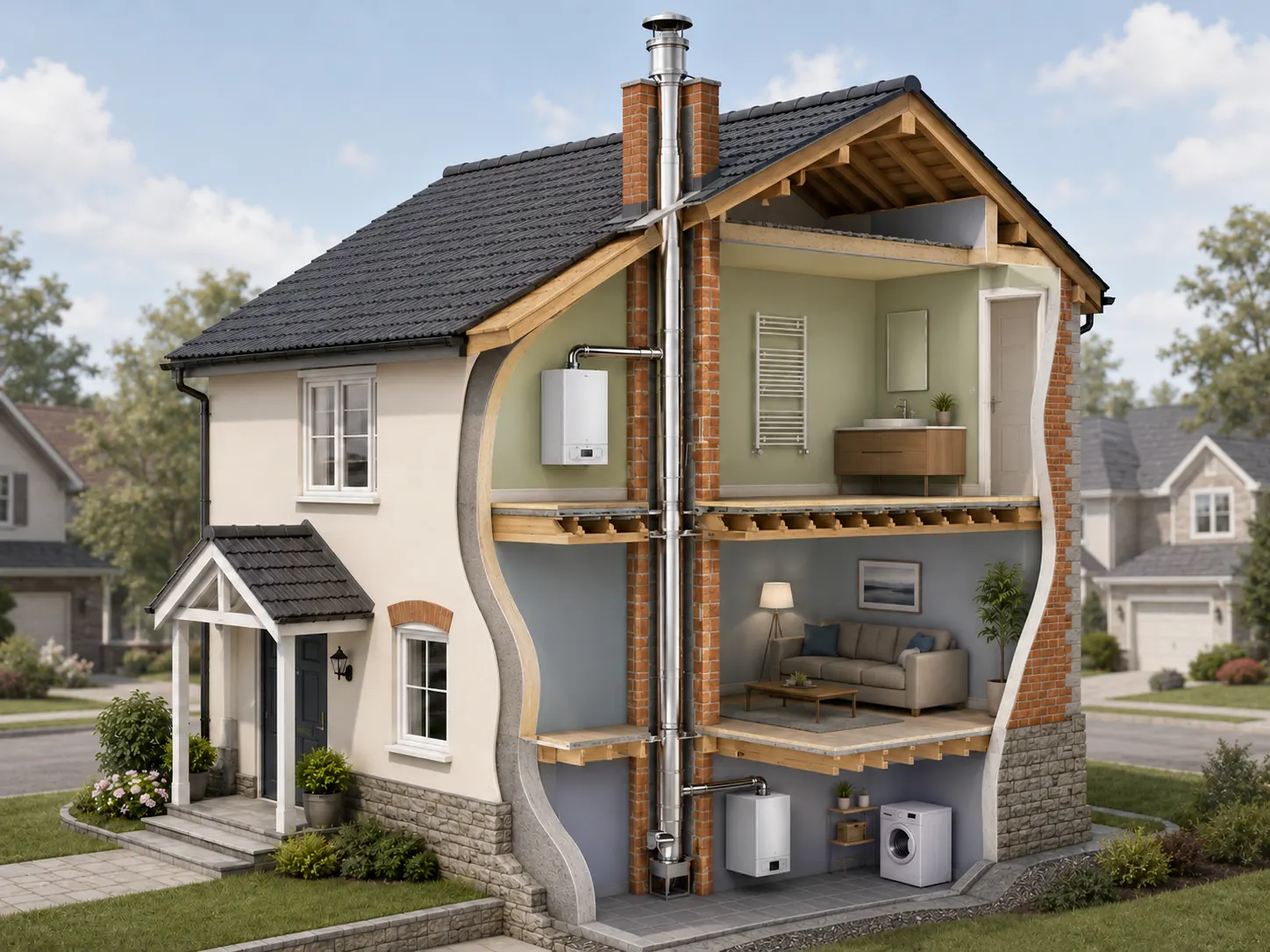
In multi-story buildings, the flue system must be planned more precisely than in a simple single-story house. What matters is not only the flue itself, but the entire route through the building: air supply, flue gas exhaust, shafts, roof outlet, maintenance access, and the documentation of the specific heating appliance.
Concentric flue-air duct systems CLV and CGF are designed for situations where one system must both supply combustion air and remove flue gases. However, these systems are not interchangeable. CLV is intended for room-sealed heating appliances, while CGF is intended for room-sealed gas fireplaces. That is why the selection should begin not with pipe diameter or an existing shaft, but with the type of appliance being connected.
Why Is Flue Gas Exhaust More Complex in Multi-Story Buildings?
In multi-story buildings, the flue system often has to pass through several structural zones: floors, shafts, walls, technical spaces, and the roof. This is relevant not only for apartment buildings. These solutions can also be important in multi-story private houses, townhouses, apartment blocks, hotels, and renovation projects.
The longer and more complex the route, the more questions must be answered in advance. Is there a suitable shaft? Will the system pass through an existing masonry duct? Will there be enough access for inspection? Is the roof outlet planned correctly? Is the flue system compatible with the heating appliance manufacturer’s requirements?
For these reasons, the flue gas exhaust solution should not be left until the final stage of the project. It should be planned together with the building structure, appliance selection, and installation conditions.
What Is a Concentric Flue-Air Duct System?
A concentric flue-air duct system performs two functions in one solution: it supplies air for combustion and removes flue gases outdoors. It is relevant for room-sealed appliances that operate independently of indoor room air.
This type of system differs from a conventional flue because it is not designed only to remove flue gases. It also provides the air supply route. This is important in modern airtight buildings, where an appliance should not rely on indoor air for combustion, as limited outdoor air supply could affect safe operation.
A concentric system must be matched to the specific appliance. Different heating appliances or gas fireplaces may have different connection, draught, pressure, temperature, and route requirements. Therefore, solutions that look similar can be technically very different.
CLV and CGF: How Are These Systems Different?
CLV and CGF are both concentric air supply and flue gas exhaust systems, but they are intended for different applications. This difference should be understood before the design process begins.
| System | Intended for | Fuel | Operating Temperature | Pressure class | Typical application |
|---|---|---|---|---|---|
| CLV | Room-sealed heating appliances | Gas or liquid fuel | ≤ 200 °C | P1 – forced draught | Boilers and other room-sealed heating appliances in multi-story buildings |
| CGF | Room-sealed gas fireplaces | Gas | ≤ 600 °C | N1 – natural draught | Gas fireplaces in homes, apartments, hotels, or leisure buildings |
The CLV system is used when combustion air must be supplied and flue gases must be removed by forced draught from room-sealed gas or liquid fuel heating appliances. The CGF system is intended for room-sealed gas fireplaces: combustion air is supplied to the appliance through the concentric system, while flue gases are removed by natural draught.
To learn more about the differences between CLV and CGF systems, their intended use, and selection criteria, see our article “Concentric Systems: CLV vs CGF — What’s the Difference and Who Is Each For?” It provides more information to help assess which system is most suitable for a specific appliance and installation situation.
Where CLV and CGF Systems Are Used: From Multi-Story Homes to Commercial Buildings
Concentric flue systems can be used in various types of multi-story buildings, so the solution must be matched to the specific appliance, building structure, and planned route.
The CLV system may be relevant where room-sealed heating appliances are designed and where air supply must be combined with flue gas exhaust through the building interior or existing ducts. The CGF system is more relevant when a room-sealed gas fireplace is planned in a multi-story building — for example, in a higher-end home, apartment, or hotel relaxation area.
Most importantly, the system must be selected according to the real usage scenario. The number of floors, route length, shaft location, appliance type, and maintenance access must all be evaluated together.
New Build and Renovation: How Does the Planning Logic Change?
In new construction, a concentric flue system is usually easier to plan. Shafts, the flue route, roof outlet, terminals, supports, and maintenance access can be considered in advance. This makes it possible to coordinate the system with the architecture and technical spaces during the design stage.
In renovation projects, the situation is more complex. Existing brick or concrete flue ducts often need to be evaluated. Although CLV and CGF systems can be installed in existing ducts, the duct itself must be checked: whether its dimensions are suitable, whether it is damaged, and whether the required route and maintenance access can be ensured.
An old duct does not automatically mean it is suitable for a new system. A new heating appliance or gas fireplace may have different pressure, temperature, condensate, and connection requirements than the previous system.
Technical Criteria That Cannot Be Ignored
When choosing a CLV or CGF system, diameter alone is not enough. The flue system must match the entire technical scenario.
First, it is necessary to know which appliance will be connected. Is it a room-sealed heating appliance or a room-sealed gas fireplace? What fuel is used? Which system is allowed or recommended by the appliance manufacturer?
Next, the temperature class, pressure class, condensate conditions, and installation route must be evaluated. CLV relevant parameters are P1 pressure class and up to 200 °C operating temperature. CGF relevant parameters are N1 pressure class and up to 600 °C operating temperature. Both systems are suitable for wet operating conditions, so condensate management and installation logic must be planned correctly.
Clearances to combustible materials, the roof outlet, terminals, supports, sealing elements, and inspection access must also be evaluated. In a multi-story building, these details become even more important because mistakes can affect more than one room or floor.
Common Mistakes When Choosing a CLV or CGF System
Mistake 1. Treating CLV and CGF as Interchangeable Systems
These systems have different purposes. CLV is intended for room-sealed heating appliances, while CGF is intended for room-sealed gas fireplaces. They should not be selected simply because both are concentric systems.
Mistake 2. Starting with the Existing Shaft Instead of the Appliance
The existing shaft is important, but the appliance requirements come first. If the shaft is not suitable for the selected appliance, the system may not operate as intended.
Mistake 3. Considering Only the Diameter
Diameter is only one parameter. Temperature class, pressure class, condensate conditions, route, clearances, and installation instructions are also important.
Mistake 4. Not Checking the Existing Duct in Renovation Projects
An old brick or concrete duct may be damaged, incorrectly sized, or unsuitable for the new appliance. Its condition must be evaluated before installation.
Mistake 5. Planning Maintenance Access Too Late
A flue system must not only be installed but also inspected. If important parts of the system cannot be accessed, later maintenance becomes more difficult.
How Vilpra Industries Helps Plan CLV and CGF Solutions
Vilpra Industries has experience in manufacturing stainless steel flue systems and processing custom stainless steel products. The company uses advanced design and production technologies, including CNC machining, robotic welding, 3D product modelling, CAD design, and flue system calculations according to EN 13384-1 and EN 13384-2 standards.
Vilpra Industries supplies not only CLV and CGF concentric flue-air duct systems, but also components related to their design and installation. This makes it possible to create a complete solution from the appliance connection to flue gas discharge through a wall, shaft, or roof.
With CLV and CGF solutions may include also terminals and fixing parts, supports, sealing components, connectors, adapters, inspection elements, and other parts required for installation. However, additional components must always be selected according to the specific system, connected appliance, building structure, and planned route.
Practical Checklist Before Choosing CLV or CGF for a Multi-Story Building
Before choosing a CLV or CGF system for a multi-story building, answer the following questions:
- What appliance will be connected: a heating appliance or a gas fireplace?
- Is the appliance room-sealed and independent of indoor air?
- What fuel is used?
- Is a CLV or CGF system required?
- What temperature class is required?
- What pressure class is required?
- Will the system pass through several floors?
- Will the system be installed in a new shaft or in an existing brick/concrete duct?
- Has the condition and size of the existing duct been checked?
- Has the roof outlet and terminal been planned?
- Are supports, sealing, and fixing elements included in the design?
- Is there access for inspection and maintenance?
- Has the solution been checked by a qualified designer or installer?
If several of these questions do not have clear answers, the system selection should be clarified before ordering products or starting installation.
Frequently Asked Questions
It is a system that supplies combustion air and removes flue gases outdoors in one solution. It is relevant for room-sealed appliances that operate independently of indoor room air.
CLV is intended for room-sealed gas or liquid fuel boilers and other heating appliances, while CGF is intended for room-sealed gas fireplaces. CLV is designed for forced draught and operating temperatures up to 200 °C, while CGF is designed for natural draught and operating temperatures up to 600 °C.
Yes. They may also be relevant for multi-story private homes, townhouses, apartment blocks, hotels, and renovation projects. The key is to evaluate the specific appliance and building structure.
Yes, CLV and CGF systems can be installed in existing brick or concrete flue ducts. However, before choosing a solution, the condition, dimensions, and technical suitability of the duct for the specific appliance must be evaluated.
Because diameter is only one parameter. Temperature class, pressure class, condensate conditions, appliance type, route, clearances to combustible materials, and installation instructions are also important.
A CLV system is relevant when combustion air must be supplied and flue gases must be removed by forced draught from a room-sealed gas or liquid fuel heating appliance.
A CGF system is relevant when a room-sealed gas fireplace is being designed and requires a concentric air supply and flue gas exhaust solution.
Yes, both systems are suitable for wet operating conditions. However, condensate formation, condensate drainage, and the installation and operating requirements of the specific system must be properly evaluated in each case.
Because the system must not only be installed correctly but also remain accessible for inspection and maintenance. As the route becomes longer and more complex, access to key parts, joints, and inspection elements becomes especially important. Without such access, inspection, maintenance, or repair may be difficult later.
The final solution should be approved by a qualified designer, installer, or other responsible specialist who has evaluated the appliance documentation, building conditions, national requirements, and the system installation instructions.
Conclusion
CLV and CGF concentric flue-air duct systems can be relevant for many types of multi-story buildings — from private homes to apartment buildings, hotels, and renovation projects. However, their selection must begin with the appliance type and manufacturer’s documentation, not with the existing shaft or flue diameter alone.
The CLV system is intended for room-sealed heating appliances, while the CGF system is intended for room-sealed gas fireplaces. The right solution must take into account fuel type, temperature class, pressure class, condensate, the route through the floors, existing ducts, maintenance access, and installation conditions.
The best result is achieved when the concentric flue system is planned as a complete technical solution — from the appliance connection to the roof outlet and future maintenance.


