


Modern homes are getting tighter (better insulation, fewer air leaks), and many appliances are designed to work independently of room air. That’s where a chimney that also brings combustion air becomes a smart—and sometimes necessary—choice.
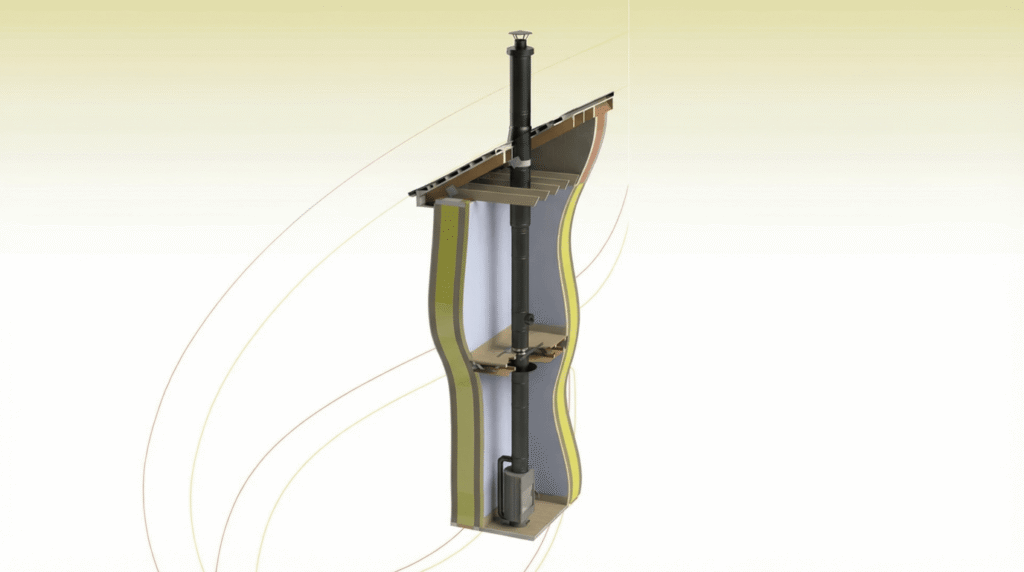
„Vilpra Chimneys TW25“ is a triple-wall air-flue chimney systemdesigned to:
- Supply combustion air to a room-sealed heating appliance and
- Convey combustion products safely to the atmosphere, using natural draught.
The following information explains when TW25 is the right choice, what it’s built for, and how to decide.
What does “room-sealed” actually mean?
Room-sealed (also called “room air independent”) appliance is built so it doesn’t take combustion air from the roomit’s installed in. Instead, it needs a dedicated air supply route. TW25 provides that air supply while also taking exhaust out through the same chimney system.
This approach helps:
- Maintain stable combustion in airtight buildings
- Reduce risk of indoor air pressure issues affecting draft
- Keep indoor air quality more consistent (no “using up” room oxygen)
What is the TW25 system?
TW25 is a triple-wall chimneyintended for gas, oil or solid-fuel appliancesthat are room-sealed and operate on natural draught (N1).
Key TW25 characteristics from the catalogue:
- Working temperature: up to 450 °C
- Pressure class: N1 – natural draught
- Condensate resistance: W – designed for wet operating conditions
- Sootfire resistance: G – resistant
- Insulation: injected mineral wool, 25 mm
- Install location: can be used inside or outside
- Product designation code: EN 1856-1 T450-N1-W-V2-L50xxx-G80
When do you need a chimney that supplies combustion air?
1) Your appliance is explicitly “room-sealed”
If the appliance manual states it must be installed as room-sealed / room air independentit needs a reliable combustion air supply that does not depend on room ventilation. TW25 is designed for exactly that use-case.
2) Your building is very airtight
In newer or renovated homes, natural infiltration is low. A traditional setup that steals air from the room can lead to:
- unstable burning,
- draft problems,
- or negative-pressure situations when extractor fans run.
A system like TW25 helps by providing a dedicated air pathway for combustion.
3) You want a cleaner, more predictable installation route (inside or outside)
Because TW25 is designed for internal or external use, it’s often chosen when the appliance is in a location where routing separate ducts would be awkward.
4) You’re using fuels where sootfire resistance matters
TW25 is classified as G – resistant (sootfire resistant), which is particularly relevant for solid fuels.
When TW25 may not be the right choice?
TW25 is a natural draught (N1) system. If your appliance requires a positive pressure (fan-assisted) air-flue system, you’re typically looking at a different category (for example, Vilpra’s CLV is classified as P1 – positive pressure and is also meant to supply combustion air to room-sealed heating appliances).
Also, for room-sealed gas fireplaces Vilpra lists a dedicated CGF concentric air-flue system for that application.
(In short: match the chimney type to the appliance’s required pressure class and application.)
Safety note: distance to combustible materials
The TW25 catalogue lists distance to combustible material ≥ 80 mm (tested non-enclosed and with insulated floor penetration).
But it also clearly notes that the actual minimum distance must follow:
- the chimney marking/designation and
- national legal acts – and if they differ, you must follow the bigger distance.
Quick decision checklist: is TW25 for you?
TW25 is a strong candidate if:
- The appliance is room-sealed / air independent
- The appliance uses natural draught (N1)
- You want a system usable inside or outside
- You need resistance to wet-condition (W) (condensate-resistant design)
- You’re installing for gas, oil, or solid fuels and value G sootfire resistance
If any of those are unclear, the catalogue’s guidance is simple: system suitability should be decided by considering the appliance manufacturer documentation, chimney installation guide and national legal acts.
Frequently Asked Questions
Can TW25 be installed outside the building?
Yes — TW25 can be used internally or externally.
What types of fuel-powered devices does the TW25 support?
Gas, oil, or solid fuel systems.
Is TW25 sootfire resistant?
Yes — classified as G (resistant).


