


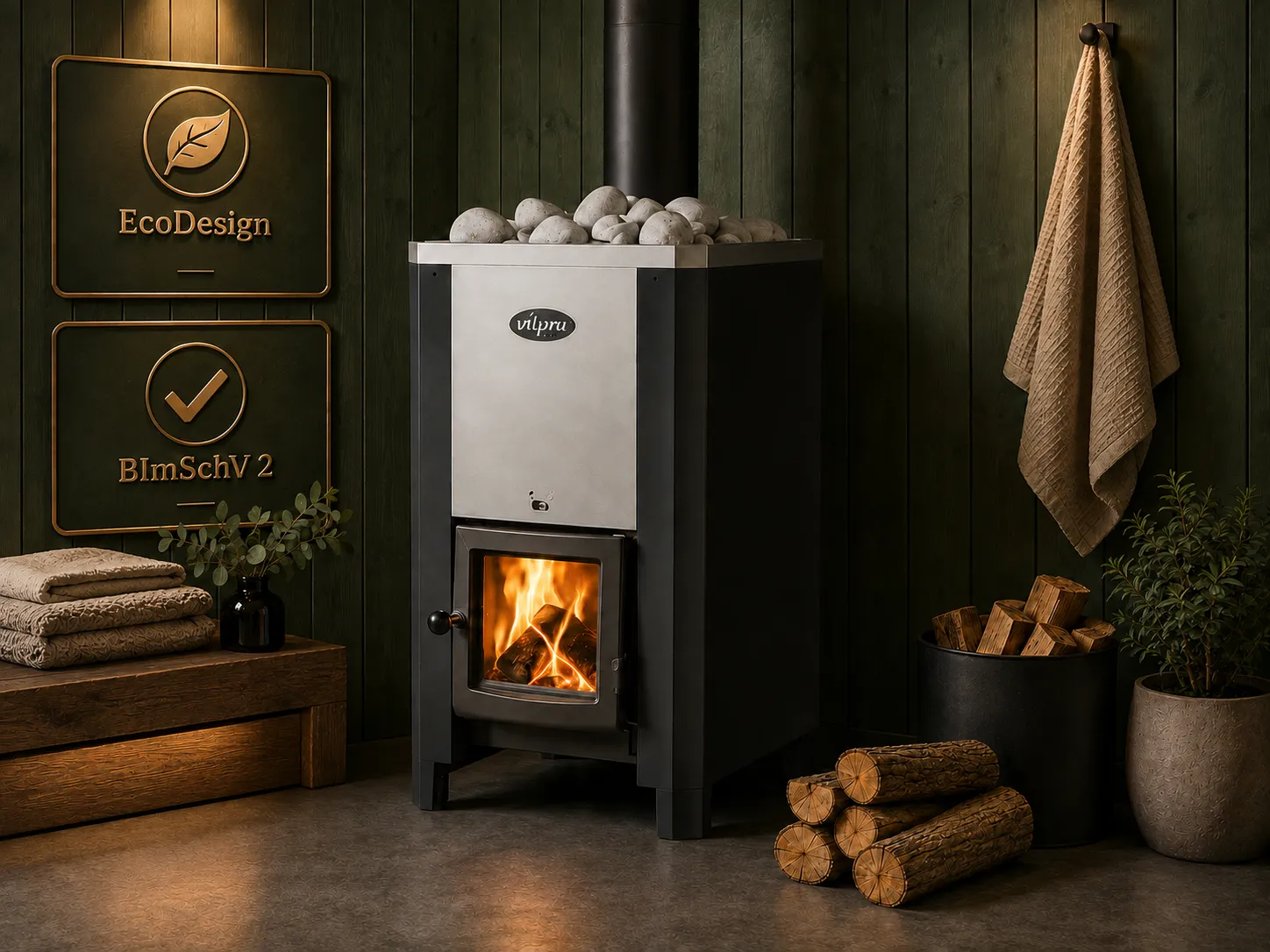
When choosing a stove, the first things people usually look at are output, size, design, or price. However, modern heating appliances are increasingly evaluated by other important criteria as well: efficiency, emissions, fuel consumption, documentation, and compliance with the requirements of different markets.
That is why technical descriptions and product catalogues often include markings such as EcoDesign or BImSchV 2These markings help show that a product is assessed not only by how it looks or how much heat it produces, but also by how efficiently it burns fuel and what emissions it produces.
In this article, we explain what the EcoDesign and BImSchV 2 markings mean and how they differ. We also discuss why an incorrectly selected or installed stove may fail to achieve the declared performance, even if the model itself meets the required standards.
Why Are Standards Becoming Important When Choosing a Stove?
Stove standards and certifications help evaluate efficiency, emissions and compliance with technical requirements. They are important not only for the end user, but also for designers, installers, and manufacturers planning to export to more demanding markets.
A properly documented product makes it clear what conditions it is designed for, what technical parameters it has, and what type of flue system it should be matched with. However, stove performance is not determined by certificates alone — fuel quality, air supply, combustion chamber design, chimney draught, and correct use are also important.
What Is EcoDesign?
EcoDesign is part of the European Union’s ecodesign requirements, related to the efficiency and environmental impact of energy-related products. For solid fuel local space heaters, Regulation (EU) 2015/1185 is relevant. It sets ecodesign requirements for placing these products on the market and putting them into service when their nominal heat output is up to 50 kW.
The logic behind this standard is simple: it evaluates not only how much heat the appliance produces, but also how efficiently it uses fuel and how many pollutants it releases into the environment. EcoDesign requirements therefore cover energy efficiency and four main emission parameters: particulate matter, carbon monoxide, nitrogen oxides, and organic gaseous compounds.
EcoDesign is relevant for wood-burning and pellet stoves as well as fireplaces. Although the same emission parameters are evaluated in both cases, the permitted limits differ depending on the appliance type:
| Emission parameter | Wood-burning stoves and fireplaces | Pellet stoves |
|---|---|---|
| Particulate matter (dust / PM) | ≤ 40 mg/m³ | ≤ 20 mg/m³ |
| Carbon monoxide (CO) | ≤ 1500 mg/m³ arba 0,12 % | ≤ 300 mg/m³ arba 0,024 % |
| Nitrogen oxides (NOx) | ≤ 200 mg/m³ | ≤ 200 mg/m³ |
| Organic gaseous compounds (OGC) | ≤ 120 mg/m³ | ≤ 60 mg/m³ |
Compliance with this standard shows that the appliance has been evaluated according to environmental and energy efficiency criteria, making it an important initial indicator for buyers.
However, the EcoDesign marking alone is not enough. The appliance must be correctly selected for the room volume, fired with dry and suitable fuel, professionally installed, and connected to a compliant chimney system.
What Is BImSchV 2?
BImSchV 2 is often used as a short way to describe the second stage requirements of Germany’s 1st BImSchV. These apply to small and medium-sized combustion systems, including wood-burning stoves, fireplaces, and pellet stoves. The principle is straightforward: the appliance must not only use fuel efficiently, but also release as few pollutants as possible into the environment.
When assessing compliance with BImSchV 2 requirements, emissions and energy efficiency are checked. During testing, it is evaluated whether the stove, fireplace, or pellet stove stays below the set pollutant limit values and achieves the required minimum efficiency.
| Evaluated parameter | BImSchV 2 requirement |
|---|---|
| Particulate matter (dust / Feinstaub) | ≤ 40 mg/m³ or 0,04 g/m³ |
| Carbon monoxide (CO) | ≤ 1 250 mg/m³ or 1,25 g/m³ |
| Minimum efficiency | Depends on the appliance type: wood-burning stoves – ≥ 73%; fireplace inserts – ≥ 73%; tiled stove inserts – ≥ 80%; pellet stoves – ≥ 85% |
| Applicable appliances | Stoves, fireplaces, tiled stove inserts, and pellet stoves |
It is important to note that specific requirements may vary depending on appliance type, fuel used, and testing method. Germany applies stricter environmental requirements, so BImSchV 2 compliance can be a good indicator when choosing a stove or another efficient solid fuel heating appliance. However, the final result depends not only on the product itself, but also on correct installation, chimney draught, and the use of suitable fuel.
EcoDesign and BImSchV 2: How Do They Differ?
EcoDesign and BImSchV 2 are different standards that assess stove efficiency, emissions, and compliance with market requirements. The main differences become clearer when comparing particulate matter, carbon monoxide, and additional pollutant limits.
| Criterion | EcoDesign | BImSchV 2 |
|---|---|---|
| Level of application | European Union requirements | German national requirements |
| Main focus | Efficiency, lower emissions, and environmental impact | Lower emissions and efficiency for the German market |
| Particulate matter, wood-burning stoves | ≤ 40 mg/m³ | ≤ 40 mg/m³ |
| Carbon monoxide (CO), wood-burning stoves | ≤ 1500 mg/m³ | ≤ 1250 mg/m³ |
| Particulate matter, pellet appliances | ≤ 20 mg/m³ | Up to 40 mg/m³ for pellet room appliances |
| Carbon monoxide (CO), pellet appliances | ≤ 300 mg/m³ | Up to 1250 mg/m³ for pellet room appliances |
| Additional pollutants assessed | NOx and OGC | These parameters are not checked separately |
| Relevant market | EU market, depending on product scope | German market |
| Why it matters to buyers | Helps evaluate product efficiency and emission level | Shows compliance with stricter German market requirements |
Although both standards set the same particulate matter limit for wood-burning stoves — ≤ 40 mg/m³ — other requirements differ:
- CO emissions: BImSchV 2 is stricter, allowing no more than 1250 mg/m³, while the EcoDesign limit is 1500 mg/m³.
- Pellet appliances: EcoDesign is stricter here, setting limits of up to 20 mg/m³ for particulate matter and up to 300 mg/m³ for CO. By contrast, BImSchV 2 formally allows up to 40 mg/m³ of dust and up to 1250 mg/m³ of CO for pellet room appliances.
- Additional parameters: EcoDesign also sets mandatory NOx and OGC limits, while BImSchV 2 does not check these parameters separately.
Therefore, the areas of application are not identical.
In simple terms, EcoDesign is more closely associated with EU-level ecodesign requirements and broader pollutant assessment, while BImSchV 2 is linked to emission and efficiency limits that are important for the German market. If a manufacturer’s documentation states that an appliance complies with both standards, this indicates that its combustion system is designed to meet different, and in some respects stricter, market requirements.
What Do These Standards Say About Stove Quality?
An EcoDesign or BImSchV 2 marking may indicate that the product has been evaluated not only for general performance, but also for efficiency and emissions. This matters because a quality stove must not only provide heat, but also burn fuel properly.
These markings help clarify:
- whether the product meets the requirements of a specific market;
- whether the appliance has clearly declared technical parameters;
- whether efficiency and emissions have been assessed;
- whether the product is suitable for more demanding projects or export markets.
However, certification is not the only quality criterion. Even a well-assessed stove will not work properly if it is chosen for the wrong room size, connected to an unsuitable chimney, or used with poor-quality fuel.
Why Is a Stove Certificate Alone Not Enough?
Stove and chimney operate as one system. Combustion quality depends not only on the stove itself, but also on chimney draught, chimney height, diameter, temperature class, installation route, clearances to combustible materials, and maintenance access.
For example, if the chimney diameter is incorrect or the draught is too weak, even an efficient stove may perform worse: it may be harder to light, produce more smoke, accumulate more soot, or fail to deliver heat as intended.
That is why stove selection should consider the full solution: stove purpose, room or sauna volume, flue outlet diameter, chimney set, installation instructions, and the recommendation of a qualified specialist.
Vilpra Industries Solutions: What Is Worth Knowing?
Vilpra sauna stove solutions, the appliance itself is not the only important element. A correctly selected and safely installed flue system also mattersThe manufacturer offers stainless steel sauna chimney sets designed for sauna stoves, which can be extended with the required elements and adapted to a specific installation situation. This allows the stove, chimney, and other connection components to be combined into one complete system that supports proper draught, efficient removal of combustion products, and safe use.
The Vilpra range includes a sauna stove marked with CE and BImSchV 2 markings FORNAX-E. This model is intended for customers looking not only for a functional sauna stove, but also for one assessed according to emission and efficiency requirements.
Main FORNAX-E characteristics:
- Recommended sauna volume: 7–13 m³;
- Stove weight: 50 kg;
- Maximum stone capacity: 30–35 kg;
- Chimney diameter: 115 mm.
In simple terms, this stove is suitable for a medium-sized sauna and can hold up to 30–35 kg of stones. When choosing a chimney, it is important to pay attention to the 115 mm diameter so that the stove is properly connected and can operate safely and efficiently.
Common Mistakes When Evaluating EcoDesign and BImSchV 2
Mistake 1. Thinking EcoDesign and BImSchV 2 Are the Same
These requirements are related to efficiency and emissions, but their application context is different. EcoDesign is an EU-level system, while BImSchV 2 is an important requirement level for the German market.
Mistake 2. Treating Certification Separately from Installation
Even a certified stove must be installed according to the manufacturer’s instructions. Incorrect connection can reduce performance and safety.
Mistake 3. Forgetting the Chimney
A stove cannot be evaluated separately from the chimney. Draught, diameter, height, and the chimney set directly affect combustion.
Mistake 4. Choosing Only by Output
Output is important, but it is not the only criterion. Room or sauna volume, stone capacity, emissions, efficiency, chimney diameter, and installation conditions should also be evaluated.
Mistake 5. Ignoring the Market Where the Product Will Be Used
If a product is intended for the German market, the BImSchV 2 marking may be an important selection criterion. Other markets may require different documentation or compliance requirements.
Practical Checklist Before Choosing a Stove
Before choosing a stove, answer the following questions:
- In which market will the stove be used?
- Is EcoDesign compliance relevant?
- Is the BImSchV 2 marking required?
- Have the product declaration and documentation been checked?
- What is the room or sauna volume?
- What is the stove output and intended use?
- What stone capacity is needed, if it is a sauna stove?
- What is the chimney diameter?
- Has the correct chimney set been selected?
- Will the system be installed according to the manufacturer’s instructions?
- Will the installation be checked by a qualified specialist?
- Does the user know the correct firing and maintenance rules?
Frequently Asked Questions
EcoDesign is a European Union ecodesign requirements system related to the efficiency and environmental impact of energy-related products. For solid fuel local space heaters, Regulation (EU) 2015/1185 is relevant.
BImSchV 2, or the second stage of Germany’s 1st BImSchV, refers to strict German requirements for small and medium-sized combustion appliances. They define what efficiency solid fuel stoves and fireplaces must achieve and what carbon monoxide and particulate matter emission limits they must meet.
No. EcoDesign defines EU-level ecodesign requirements, while BImSchV 2 refers to national German emission and efficiency standards.
Small and medium-sized combustion systems intended for the German market are subject to strict emission and efficiency requirements. Therefore, BImSchV 2 compliance may be relevant when choosing a product intended for use or sale in Germany.
Yes. Even a certified stove must be connected to a suitable flue system. Chimney diameter, height, draught, temperature class, and installation route must match the appliance requirements.
EcoDesign is a European Union requirement framework that defines stove efficiency, emissions, and energy-use criteria. BImSchV 2 is a stricter German requirement level focused primarily on particulate matter and carbon monoxide emissions as well as minimum appliance efficiency.
No. Certifications and markings are important, but the stove still needs to be selected according to sauna volume, stone capacity, chimney diameter, installation conditions, and the manufacturer’s documentation.
Because combustion quality and safe operation depend not only on the stove, but also on flue gas exhaust. An unsuitable chimney can reduce draught, increase smoke, and make appliance operation more difficult.
Conclusion
EcoDesign and BImSchV 2 are similar in that both evaluate stove efficiency and emissions, but they are not the same standard. EcoDesign defines European Union ecodesign requirements, while BImSchV 2 sets emission and efficiency criteria for the German market. These markings can therefore be a useful indicator when looking for a more efficient appliance with lower emissions.However, when choosing a stove, it is also important to consider other key factors: room or sauna volume, appliance output, chimney compatibility, installation conditions, fuel type, and the manufacturer’s recommendations.


