


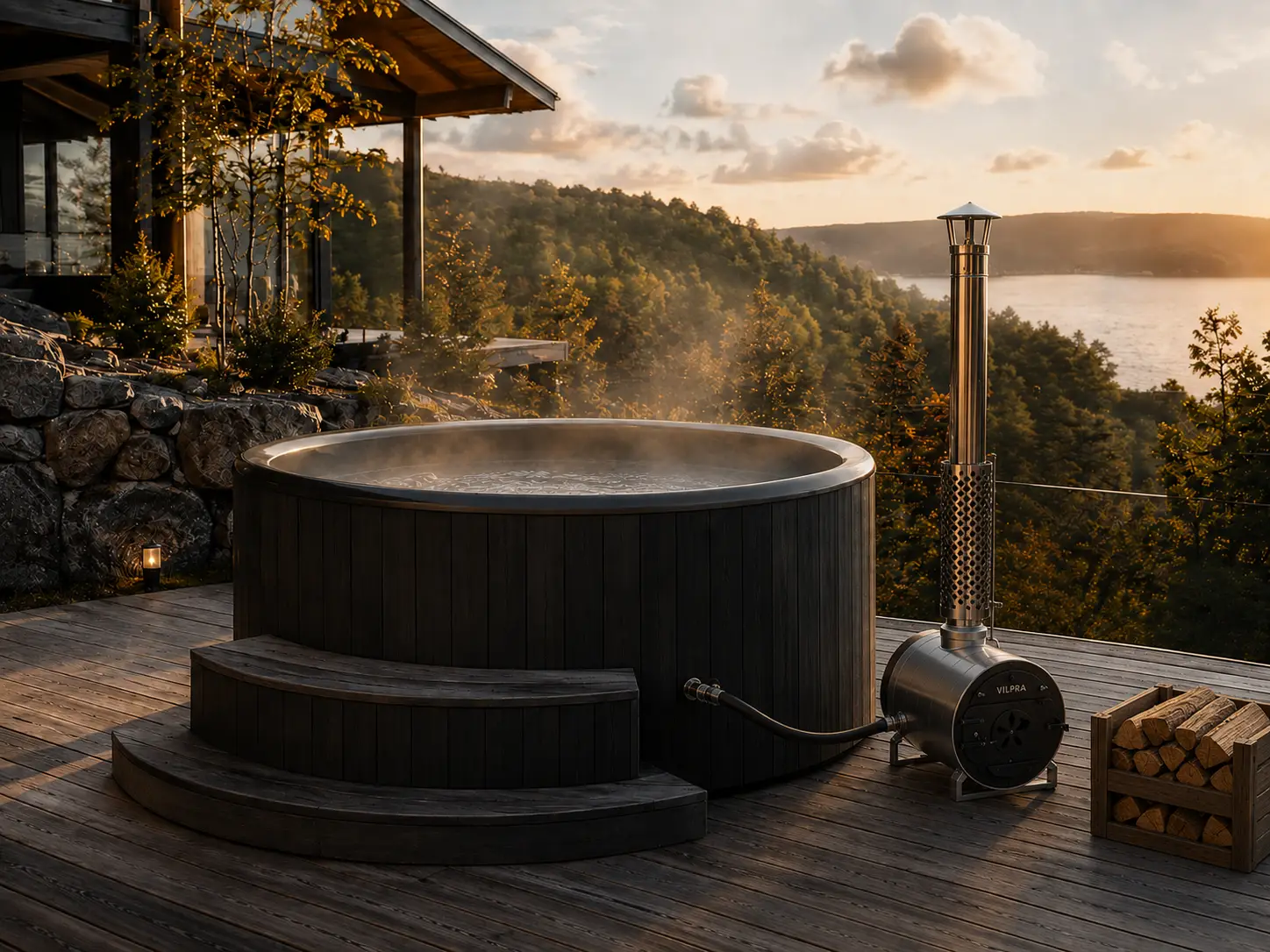
An external hot tub heater is installed next to the hot tub and heats the water through a connected circulation system. This means that firing and maintenance tasks remain separate from the bathing area. The selected heater affects how quickly the water heats up and how convenient the hot tub is to use and maintain, so it is important to evaluate the water volume, desired heating time, season of use, and installation location.
In this article, we explain how to choose an external wood-fired hot tub heater based on specific usage conditions, what output may be suitable for different hot tub sizes, and when the right balance between heating speed, fuel use, and everyday convenience matters more than simply choosing the highest output.
Why Is an External Hot Tub Heater a Convenient Solution?
When the heater is outside, more space is left for bathing. It is also easier to access the firebox, add wood, clean out ashes, and perform maintenance. The firing area is clearly separated from the relaxation area, which is especially convenient when several people are using the hot tub.
An external heater also makes it easier to plan the smoke outlet, firewood storage area, and service access. This is important not only for comfort, but also for safer everyday use.
Where to Start: Hot Tub Water Volume and Usage Scenario
The first question when choosing a hot tub heater is how much water needs to be heated. The larger the hot tub water volume, the more energy is required to reach bathing temperature.
However, the number of litres alone is not enough. You should also consider how the hot tub will be used:
- whether the hot tub is intended for 2–4 people or a larger group;
- whether it will be used only in summer or all year round;
- whether the water is heated from completely cold;
- whether the hot tub is located in an open, windy area;
- whether a cover is used during heating;
- whether fast heating is important or whether a longer heating time is acceptable.
The same heater can perform very differently in a small hot tub in summer and in a larger outdoor hot tub in winter. That is why heater selection should not begin with the question “what output is needed?”, but with the real usage scenario.
How to Evaluate Output: Water Volume, Temperature Difference, and Real Conditions
The best way to understand heater output is through a simple principle: the more water needs to be heated and the greater the difference between the starting and target temperature, the more energy will be required.
You can use this indicative formula:
Required energy in kWh ≈ water volume in litres × temperature increase °C × 0.00116
For example, if the hot tub contains 1000 litres of waterand the temperature needs to be raised from 10 °C to 38 °Cthe difference is 28 °C.
1000 × 28 × 0,00116 ≈ 32,5 kWh
In theory, a 15 kW heater would transfer this amount of energy in about 2.2 hourswhile a 30 kW heater would do so in about 1.1 hours.In reality, heating time will be longer because some heat is lost through the hot tub walls, water surface, smoke, surrounding air, and due to fuel quality.
This calculation is not an exact promise of heating time. It helps explain why a more compact heater may be enough for one hot tub, while another may require a more powerful solution.
In practical terms:
- 25 kW heater is better suited to smaller water volumes, lighter use, warmer seasons, or situations where rapid water heating is not the main priority.
- 60 kW heater is better suited to larger water volumes, more frequent use, colder seasons, more exposed locations, or situations where faster heating is desired.
Water Circulation: Why Is Natural Circulation Important?
In an external hot tub heater, water must circulate between the hot tub and the heater. One of the most convenient solutions is natural water circulation.
It works because of temperature differences: heated water rises from the heater into the hot tub, while cooler water flows back down into the heater. In this case, no additional water pump or electrical connection is required.
This is especially convenient for outdoor hot tubs, countryside properties, and relaxation areas where additional electrical equipment is not always desired. However, natural circulation only works properly when the heater is installed correctly: connections, heights, and installation direction must follow the manufacturer’s instructions.
Material and Durability: Why Stainless Steel Matters?
A hot tub heater works in demanding conditions: it is exposed to water, heat, ash, and the outdoor environment. Moisture, temperature changes, rain, snow, and improper maintenance can accelerate wear.
That is why stainless steel is an important advantage. It helps provide better corrosion resistance, longer service life, and easier maintenance. However, even a stainless steel heater must be maintained according to the manufacturer’s instructions: ashes should be cleaned out, the system should not be allowed to freeze with water inside, and aggressive chemicals should be avoided.
Installation Location: What to Consider Before Positioning the Heater
The location of an external hot tub heater must be convenient and safe. It should be easy to access with firewood, simple to refuel, and practical to clean after use.
Before installation, consider:
- whether the heater will be too close to combustible materials;
- whether smoke will be directed toward a terrace, windows, or seating area;
- whether the base is stable;
- whether it will be convenient to connect the heater to the hot tub;
- whether the water connections will be in the correct position;
- whether the hot tub will be convenient to use in winter;
- whether maintenance access is planned.
A good installation location affects not only safety, but also everyday convenience. Even a high-quality heater can become inconvenient if it is difficult to reach, difficult to clean, or if smoke travels toward the seating area.
Fuel Quality and Firing Habits
Firewood quality has a direct effect on water heating speed. Dry firewood burns more efficiently and helps transfer heat to the water faster. Wet wood uses part of its energy to evaporate moisture, which makes heating slower and creates more smoke and soot.
A hot tub heater should be fired with dry, suitable firewood. Painted, impregnated, glued wood, construction waste, and rubbish should not be burned.
It is also important not to overload the heater with wood. It is better to fire it steadily, adding fuel regularly and monitoring the water temperature. After use, ashes should be cleaned out and the system should be prepared for the next firing.
Common Mistakes When Choosing an External Hot Tub Heater
Mistake 1: Choosing Only by Price
The cheapest option is not always the most suitable one. If the heater is too weak for the hot tub water volume or not suitable for winter use, the water will take too long to heat and the overall experience will be worse.
Mistake 2: Ignoring Water Volume
The number of litres in the hot tub directly affects how much energy is required. A small hot tub and a large hot tub need different heating solutions.
Mistake 3: Ignoring the Temperature Difference
Heating water from 20 °C to 38 °C in summer is one situation. Heating it from 5 °C to 38 °C in autumn or winter is completely different. The greater the temperature difference, the longer the heating process will take.
Mistake 4: Forgetting the Season of Use
Winter, wind, an exposed location, and not using a cover mean greater heat losses. In such cases, it is worth choosing a heater with more reserve.
Mistake 5: Underestimating Maintenance
Ash cleaning, access to the heater, water draining, and frost protection should be planned in advance.
Mistake 6: Poor Smoke Outlet Planning
If smoke travels toward the terrace, windows, or relaxation area, even a good heater will become inconvenient in everyday use.
Vilpra Industries Hot Tub Heaters: A Reliable Solution for Convenient Water Heating
When choosing a Vilpra Industries hot tub heater, it is worth looking not only at the 25 kW or 60 kW output number, but at the entire construction solution. A hot tub heater should be durable, easy to maintain, clearly installed, and suitable for working with water and outdoor conditions.
Vilpra Industries’ experience in stainless steel products and smoke exhaust systems allows the hot tub heater to be viewed as a complete technical solution. This is especially relevant when planning an outdoor spa, sauna, or relaxation area where not only heating speed matters, but also reliability, maintenance, and installation logic.
| Vilpra hot tub heater | Output | Dimensions | Practical direction |
|---|---|---|---|
| HEATER-EX-CH-VP1-V | 25 kW | 498 × 600 × 410 mm | A more compact solution for smaller water volumes or when rapid heating is not required |
| HEATER-EX-CH-VP2-V | 60 kW | 650 x 610 x 810 mm | For larger water volumes, more frequent use, colder seasons, or when faster heating is desired |
HEATER-EX-CH-VP1-V heater weighs 20 kg, has a firebox size of 430 × 350 × 230 mm, a heat transfer fluid volume of 20 l, a heat exchanger surface area of 0.75 m², and 6 mm insulation thickness.
Both Vilpra hot tub heaters are made from stainless steel, designed for easy installation and maintenance, and water circulation takes place naturally — without a water pump or electrical connection.
Practical Checklist Before Choosing a Hot Tub Heater
Before choosing an external hot tub heater, answer these questions:
- What is the hot tub water volume in litres?
- What is the usual starting water temperature?
- What temperature do you want to reach?
- Will the hot tub be used in summer or all year round?
- Is the hot tub located in a windy or exposed area?
- Is a cover used during heating?
- Is fast heating important?
- Would a slower but more compact solution be acceptable?
- Will it be convenient to access the heater with firewood?
- Is ash cleaning access planned?
- Can smoke be safely discharged?
- Will you have dry firewood?
- Will the heater be installed according to the manufacturer’s instructions?
Frequently Asked Questions
An external heater is installed next to the hot tub, so it does not take up space inside the tub. It is also easier to access for firing, ash cleaning, and maintenance.
An internal heater can be a compact solution, but it reduces bathing space and may be less convenient to service.
You should consider water volume, temperature difference, season, outdoor conditions, cover use, and desired heating speed.
The more water there is and the colder the environment, the more heat reserve will be needed.
Not always. A 60 kW heater can heat a larger water volume faster, but for a smaller hot tub, warmer seasons, or lighter use, a more compact 25 kW solution may be sufficient.
The goal is not to choose the biggest number, but the solution that best matches the hot tub volume and usage conditions.
The more water there is in the hot tub, the more energy is needed to raise its temperature. That is why a larger hot tub usually needs either a more powerful heater or a longer heating time.
It depends on the specific model. In the case of Vilpra hot tub heaters, water circulation takes place naturally, so no water pump or electrical connection is required.
A hot tub heater is constantly exposed to water, heat, and outdoor conditions. Stainless steel helps ensure better corrosion resistance, durability, and easier maintenance.
It is best to use dry, suitable firewood. Painted, impregnated, glued wood, construction waste, and rubbish should be avoided.
Dry firewood burns more efficiently, produces less smoke, and helps heat the water faster.
You should check the hot tub water volume, heater location, water connections, smoke outlet, maintenance access, base stability, and the manufacturer’s installation instructions.
Conclusion
The most important factors are hot tub water volume, desired heating speed, season of use, outdoor conditions, fuel quality, and installation location. Only then is it possible to understand whether a more compact or more powerful external heater is the better choice.
For a smaller hot tub or warm-season use, a more compact heater may be enough. For a larger water volume, winter use, or faster heating, a more powerful model may be the better option.


